Field failure pressure
Teams need to recreate field failure behavior from ROS 2 bag, LiDAR, odometry, point cloud, and behavior tree state data instead of arguing from incomplete tickets and video clips.
SimPatch is a proof system for robotics and autonomous machine teams. It turns a field failure, ROS 2 .db3 bag, LiDAR and odometry sensor trace, BehaviorTree.CPP XML, Gazebo or Isaac Sim simulation scenario, patch candidate, verification queue, safety case, regression ledger, and fleet rollout decision into one evidence-ready workflow.
When robots are already in warehouses, yards, plants, farms, and construction sites, a patch is not just code. It is evidence, timing, risk, safety, insurance exposure, and customer trust.
Teams need to recreate field failure behavior from ROS 2 bag, LiDAR, odometry, point cloud, and behavior tree state data instead of arguing from incomplete tickets and video clips.
Every BehaviorTree.CPP patch candidate needs reviewer context, Gazebo or Isaac Sim scenario coverage, regression ledger history, and an ISO 10218 / IEC 61508 safety case before rollout.
The cost of failure is downtime, unsafe machine behavior, legal exposure, insurance escalation, and slow enterprise acceptance.
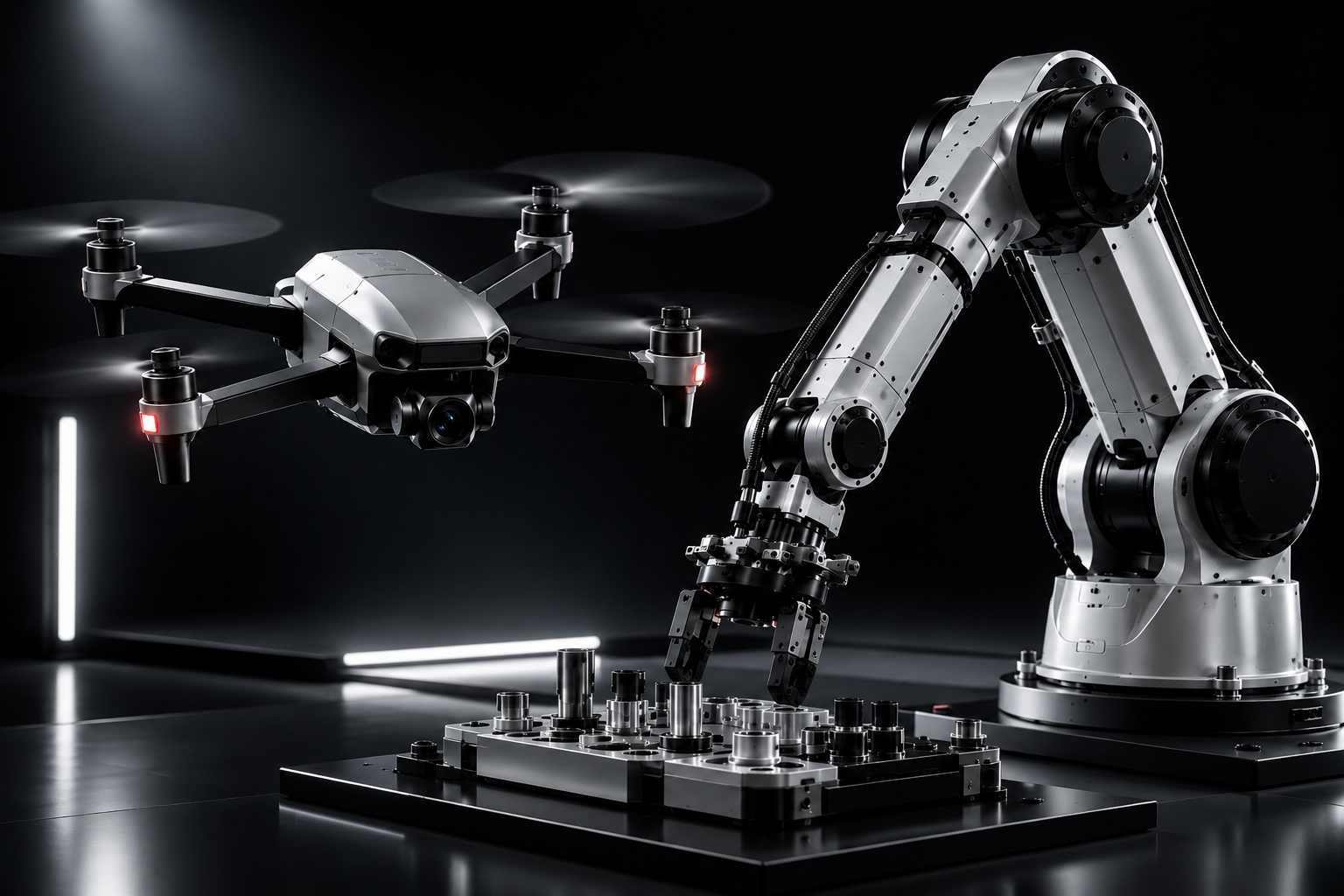
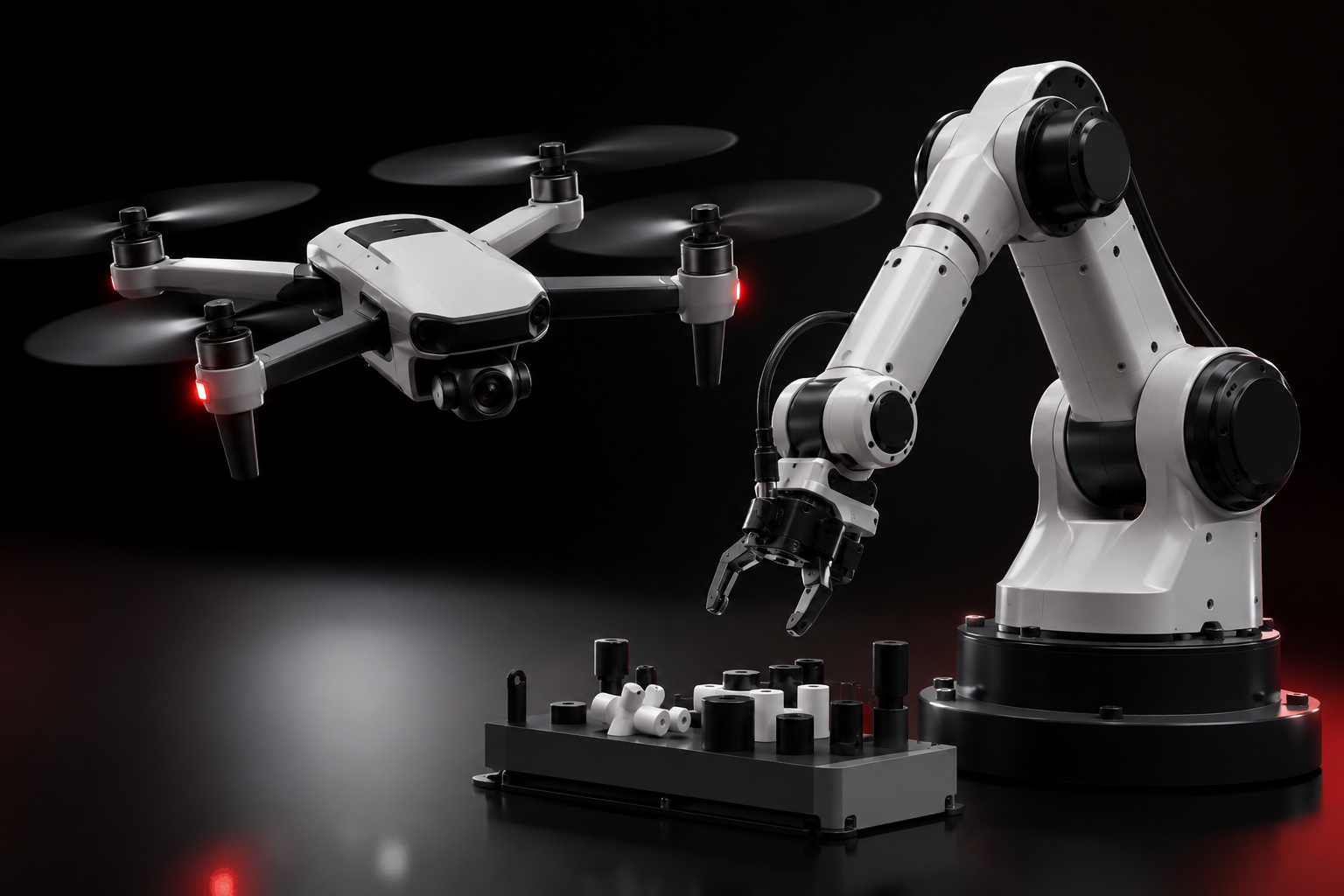
These advertising visuals carry sculptural 3D depth, glossy and matte material contrast, rim lighting, and motion-ready robot forms into the buyer experience. The message stays concrete: robotic arms and inspection drones fail in the field, and SimPatch turns those failures into governed patch evidence.
The supplemental source package expands the product from a single ROS 2 patch demo into a governance layer for world-model-ready robot failures. SimPatch prepares the Scenario Packet Builder, synthetic edge-case set, Action Prediction Panel, Patch Confidence Score, Sim fidelity score, human review gate, fleet rollout gate, and evidence packet for safety teams.
Generate structured scenario packets from robot incidents so the same failure can be routed to Gazebo, Isaac Sim, Omniverse, or future Cosmos-style physical AI adapters without changing the safety-governance contract.
Perturb lighting, reflectivity, wet floors, human crossing, payload shift, sensor noise, and starting position so a patch is challenged beyond one exact historical log.
Show the likely unsafe next action, the safer corrected behavior, blocked actions, and human-in-the-loop requirement before a patch can advance toward fleet rollout.
SimPatch is vendor-neutral and world-model-ready, with scenario packets designed to support Gazebo, Isaac Sim, Omniverse, and future physical-AI adapters as the customer stack expands.
The workflow supports inspection, logistics, maintenance, rescue, warehouse, construction, and autonomous machine safety. Restricted weaponized or lethal robotics workflows are blocked from the safety demo path.
Every output remains tied to scenario packet, synthetic variants, confidence scoring, simulator compatibility, residual risk, and human reviewer approval.
The source research says AMR and industrial robotics growth is moving from approximately $15.5 billion in 2024 toward more than $35 billion by 2034. As warehouse AGVs, drone inspection units, and autonomous construction machines scale, field-failure remediation becomes the bottleneck.
Engineers extract logs, recreate the scenario in Gazebo or Isaac Sim, hypothesize the root cause, write a C++ or XML behavior tree patch, validate it, document it, and then deploy OTA. That cycle can take 2-4 weeks per failure.
The source package cites unplanned downtime averaging $260,000 per hour and $1.4 trillion annually across the Fortune 500. For robotics operators, grounded machines mean lost revenue, breached SLAs, and stalled deployments.
SimPatch targets 2-4 days from field failure to reviewed patch package for supported behavior-tree and 2D navigation failures, with a $5,000 per-incident model and $40,000/year fleet license.
ROS 1 Noetic reached end-of-life in May 2025, and the source package cites roughly 85% of robotic arm brands offering ROS 2 drivers. That creates a common middleware target for patch tooling.
LLM-based Automated Program Repair has crossed from research to enterprise utility. The source package cites Meta AutoPatchBench as evidence that code generation and verification are becoming measurable.
ISO 10218-1:2025 and ISO 10218-2:2025 make functional safety requirements explicit. The EU AI Act, Regulation EU 2024/1689, creates technical-documentation and human oversight pressure for high-risk autonomous systems.
Gazebo Ionic and Isaac Sim 5 point toward higher-fidelity failure recreation, including physical-space event generation. SimPatch uses this as simulation-in-the-loop evidence, not as a claim of perfect real-world safety.
Safety teams need traceability logs, reviewer approval, residual-risk notes, and generated safety-case documentation before accepting machine-behavior changes.
VP of Engineering, Director of Robotics Software, and Fleet Operations Manager buyers cannot tolerate four-week MTTR when a grounded fleet damages uptime, SLA posture, and customer deployments.
An AGV 3D iToF depth camera meets a reflective shrink-wrapped pallet, miscalculates depth, collides, and triggers an E-stop.
The robot is grounded and the warehouse aisle is blocked until humans clear and reset the machine.
Technicians pull gigabytes of ROS bag files: sensor data, point clouds, behavior tree states, /tf, and /odom.
Engineers spend 1-2 weeks recreating lighting, reflectivity, geometry, and physics in Gazebo or Isaac Sim.
Root cause work produces a C++ or XML behavior tree patch, such as adding BackUpAndSpin recovery before failure.
Safety case documentation, human review, residual risk, and OTA rollout controls are required before deployment.
| Cost element | Current workflow | SimPatch target |
|---|---|---|
| Fleet example | 50 AGVs, one critical software failure per month | Same fleet, routed through the SimPatch proof loop |
| MTTR | 3 weeks / 504 hours | 3 days / 72 hours for supported failures |
| Downtime cost | $50,400 per incident | $7,200 per incident |
| Engineering labor | $12,000 per incident | $1,200 review-only labor |
| Total incident cost | $62,400 | $8,400 |
| Savings | none | $54,000 per incident, before compliance-time savings |
The customer sees the full chain, not a pile of dashboards. The product demo is the work.
Capture symptom, machine class, severity, and operating context.
Attach .db3 bag data, LiDAR, odometry, control messages, and replay markers.
Build a world-model-ready Scenario Packet Builder output with simulator targets, safety constraints, and telemetry evidence.
Generate synthetic edge cases and Action Prediction Panel output before sending the failure to Gazebo, Isaac Sim, Omniverse, or future Cosmos-style adapters.
Create a BehaviorTree.CPP patch draft, score Patch Confidence and Sim fidelity, and block restricted-use robot workflows.
Route the safety case, evidence packet, human review gate, and fleet rollout gate through controlled release.
SimPatch now adds visible neural-adaptive analysis to the proof workflow: trace classification, learned BehaviorTree.CPP patch parameters, regression memory, evidence assembly, and canary rollout scoring. The customer sees the intelligence behind the recommendation instead of a black-box answer.
Named neural methods turn field data into reviewable signals for the customer workstation.
Adaline LMS adaptation shows learned safety margin, backup distance, timeout, and parameter delta.
Hebbian memory and canary scoring show risk association, confidence movement, and supervised rollout recommendations.
This is the buyer-visible application flow: incident intake, patch candidate generation, simulation replay, safety-case review, and fleet rollout evidence.
Post a field failure from a robot or autonomous machine and attach ROS 2 .db3 bag and sensor trace context.
Generate a BehaviorTree.CPP XML patch candidate and code diff with simulation constraints and safety guardrails.
Replay the Gazebo or Isaac Sim simulation scenario and return SIM-VERIFIED or needs-patch-iteration evidence.
Record reviewer verdict, ISO 10218 / IEC 61508 notes, and approval state for the safety-case packet.
Show risk score, evidence ready, confidence, coverage, SLA, and board packet readiness.
Connect simulation, patch, rollout, safety case, and regression ledger into one decision recommendation.
Foxglove, Rerun, rosbag, Formant, FleetOps, Applied Intuition, Cognata, and AWS RoboMaker all solve important slices. SimPatch sits in the decision gap between field failure, generated patch candidate, safety case, and controlled fleet rollout.
| Alternative / competitor baseline | Useful for | Gap SimPatch fills |
|---|---|---|
| Foxglove, Rerun, rosbag | Trace visualization and debugging. | They do not govern patch candidate approval, safety case evidence, and rollout gates as one proof chain. |
| Formant, FleetOps | Fleet visibility and operations. | They do not package field failure reproduction into self-generating code software and reviewer-ready patch evidence. |
| GitHub Copilot and generic coding assistants | General code suggestions. | They lack ROS 2 middleware context, physical-world constraints, and Gazebo verification of whether the robot avoids collision. |
| Manual simulation workflows | Hand-built Gazebo or Isaac Sim reproduction. | They are slow and subjective when recreating lighting, reflectivity, sensor noise, and physical layout. |
| Traditional Automated Program Repair | Syntax errors, memory leaks, and software-only defects. | They do not handle cyber-physical bugs where failure is distance < 0.3m or another violated safety constraint. |
| Applied Intuition, Cognata, AWS RoboMaker | Simulation and test environments. | They do not become the customer proof command center for board packet, ROI, SLA, and legal exposure decisions. |
| Gazebo, Isaac Sim, Omniverse, Cosmos-style world models | Physics replay, scene generation, action prediction, or future physical AI training loops. | They need a vendor-neutral Scenario Packet Builder, Patch Confidence Score, Sim fidelity score, dual-use safety gate, human review gate, and evidence packet layer before buyers can trust patch rollout. |
The source package cites a 2024 Waymo pole-detection incident and recall of 672 vehicles as evidence that autonomy edge cases can require fleet-wide software updates.
Depth cameras can struggle with thin objects, reflective surfaces, or height estimation errors, causing collisions and gripper damage in warehouse environments.
Dense robot environments produce rare edge cases at operational scale. The source package uses these as comparable signals, not as direct SimPatch proof.
REST API intake for a ROS 2 .db3 bag from a known failure, including LiDAR, odometry, camera frames, behavior tree state, /tf, and /odom.
Headless Gazebo with a TurtleBot4 or generic differential-drive AGV model, plus scenario generation from odometry and LiDAR data.
An LLM prompt receives current BehaviorTree.CPP XML and proposes a recovery behavior such as BackUpAndSpin before the failure state.
The orchestrator applies the XML patch, restarts the ROS 2 navigation stack in Gazebo, monitors /tf and /odom, and tags passing runs SIM-VERIFIED.
The dashboard must show Incident Queue, Diff Viewer, Simulation Replay, Gazebo pass/fail status, and a downloadable PDF safety case.
The upgraded workstation adds trace classification, adaptive patch parameters, regression memory, evidence assembly, and canary rollout scoring.
| Layer | Whitepaper target | Current status |
|---|---|---|
| Frontend | React + TypeScript + TailwindCSS with Dashboard, Incident Queue, Log Viewer, and Safety Case Review | Premium customer dashboard with neural evidence panels, incident queue, rollout review, and access-key protection. |
| Backend | Python FastAPI with rosbags parsing and LLM orchestration | Flask POC with ROS bag metadata and patch endpoints; full rosbags parser pending |
| Database/storage | PostgreSQL and S3 for ROS bags and generated safety PDFs | SQLite-backed entitlement and evidence records now; production storage can expand as customer volume grows. |
| Simulation | Kubernetes with GPU-enabled Gazebo or NVIDIA Isaac Sim jobs | Runner connection layer supports customer-hosted or managed Gazebo/Isaac evidence workflows. |
| AI orchestration | LangChain or LlamaIndex connected to ROS 2 fine-tuned foundation models | Deterministic patch generation plus neural-adaptive scoring and evidence assembly. |
| Auth | OAuth2 / OIDC for enterprise SSO | Payment entitlement/access-key layer exists; enterprise SSO pending |
When a robot fails, expensive engineers spend weeks pulling logs, tweaking simulators, and guessing at fixes. SimPatch takes field failures, automatically reproduces them in simulation, generates and verifies the patch, and turns weeks of downtime into days of uptime with safety documentation to prove it.
Run a Free Pilot on Your Toughest Bug: give SimPatch one historical ROS bag file from a past failure that took weeks to fix. The target offer is a verified patch and safety case in 48 hours for qualified pilots.
SimPatch reduces field-failure-to-patch time from weeks to days for supported behavior-tree/navigation failures.
Generates safety documentation structured for ISO 10218 compliance and human review.
Perturb starting position, lighting, reflectivity, and sensor noise so the patch is not overfit to one exact log.
Calculate risk exposure reduced by patching a specific failure across a fleet.
Use control-theory reachability analysis where possible to strengthen guarantees beyond empirical simulation.
Patch candidates stay connected to Gazebo or Isaac Sim replay, scenario coverage, and measurable confidence scores.
The workstation gives engineering and safety leaders a clear decision surface before fleet rollout.
The customer sees named neural methods, confidence movement, parameter deltas, regression memory, and canary recommendations.
Engineering, safety, operations, and insurance-facing buyers need a direct answer before spending money.
VP of Engineering, Director of Robotics Software, Fleet Operations Manager, autonomous machine safety owners, and enterprise risk teams that need evidence before releasing machine behavior into the field.
Map the field failure, machine class, telemetry needed, and first simulation replay requirement.
Compare patch-candidate cycle time, replay coverage, and review delay against the current repair workflow.
Turn repeated failures into a governed patch-verification motion with review evidence and rollout controls.
The customer keeps paying for repeat incidents, downtime, unsafe rollout risk, unresolved legal exposure, and engineers doing manual reconstruction work.
Engineering and safety stop debating from incomplete notes. Operators see what changed, what was simulated, what passed, and what should wait.
Enterprise buyers pay for lower risk, faster patch decisions, and board-ready proof. The budget logic is one avoided unsafe rollout or one shortened acceptance cycle.
One historical ROS 2 bag run through the incident-to-SIM-VERIFIED proof loop.
30-day Gazebo replay, BehaviorTree.CPP patch candidate, and safety-case pilot.
Annual licensed workspace for up to 50 robots with customer docs, activation, license status, and rollout governance.
For larger pilots, the pricing story now includes World Model Lab governance and the Neural-Adaptive Evidence Engine: Scenario Packet Builder, synthetic edge-case generation, Action Prediction Panel, trace classification, learned patch parameters, regression memory, Patch Confidence Score, Sim fidelity scoring, compatibility matrix, quality-control gate, and human-review evidence packet.